- Heddels
- Posts
- The Brannock Device – A Better Way to Measure Feet
The Brannock Device – A Better Way to Measure Feet

David Shuck
April 15, 2026
Together With


The Brannock Device – A Better Way to Measure Feet
In this historical revue, we tackle the Brannock Device, the system that revolutionized how we buy and make shoes.
James Smith

Even if you don’t know what it’s called, chances are you’ve known the icy, calculated touch of the machine known as the Brannock Device. The two-pound block of milled steel has been the gold standard for measuring feet for almost 90 years now, as well as one of the longest enduring symbols of post WWI modernism.
Inventor Charles F. Brannock was born into the shoe business. His father was the co-owner of a shoe store in Syracuse, New York, and Charles spent a good part of his college years designing a better way to measure the shape of the human foot.
Standard shoe sizes were only a couple of generations old at that point (a necessity of equipping troops in the Civil War), and the only measuring device available was a primitive wooden caliper called the RITZ Stick, which measured length and length alone. But as our treatise on footwear lasts will tell you, that’s not nearly enough to ensure a proper fit.
/ In Partnership with Blue Beach Denim /

ONI’s latest drop is its 15 oz. Ishikawadai selvedge. Ishikawa-dai is a vintage Japanese-made ring-spinning machine, said to be the oldest cotton-spinning machine still operating in Japan. Cotton is ring-spun all over the world, but no other spinning machine can produce yarns like the Ishikawa-dai. Compared to the latest machines, Ishikawa-dai spins at a slower speed of about one-third, resulting in lower productivity, but also a rich, natural texture.
ONI’s Ishikawadai denim puts rope-dyed Ishikawadai yarns through a specialized loom to create a totally unique selvedge denim. This isn’t just a matter of craftsmanship, but of extreme patience: in today’s Japanese denim industry, production is booked onto these looms at least 24 months in advance. Because every loom is running at capacity daily, a sold-out run can take up to 3 years to restock.
“There is only 1 loom that able to produce ONI Ishikawadai denim in the world. It can experience failure or breakdown at any time. Making the denim extra precious and valuable.” – Oishi San, ONI Denim
Weighing in at 15 oz. per square yard, this mid-to-heavyweight fabric utilizes Ishikawa-dai yarns in both the warp and weft—with the warp dyed a bluey-green shade of indigo reminiscent of old world denim. You only have to look at the close-ups to see how special this fabric is; it retains a distinct ‘ONI’ feel without any hyper-slub or nep. The Ishikawadai is available across a range of ONI jean cuts from slim-straight all the way to extra-wide, with some options featuring 2% stretch for the comfort crew. In addition, there is a duo of denim jackets: a traditional Type 1, and a ‘Type 0‘ silhouette based on late 19th century blousons with dual pockets at the hip. Each piece is made in Japan and comes with custom-branded ONI hardware and a demonic natural leather waist patch that echoes the teal hues of ONI’s Ishikawadai denim.
Shop ONI Ishikawadai Denim at Blue Beach Denim today
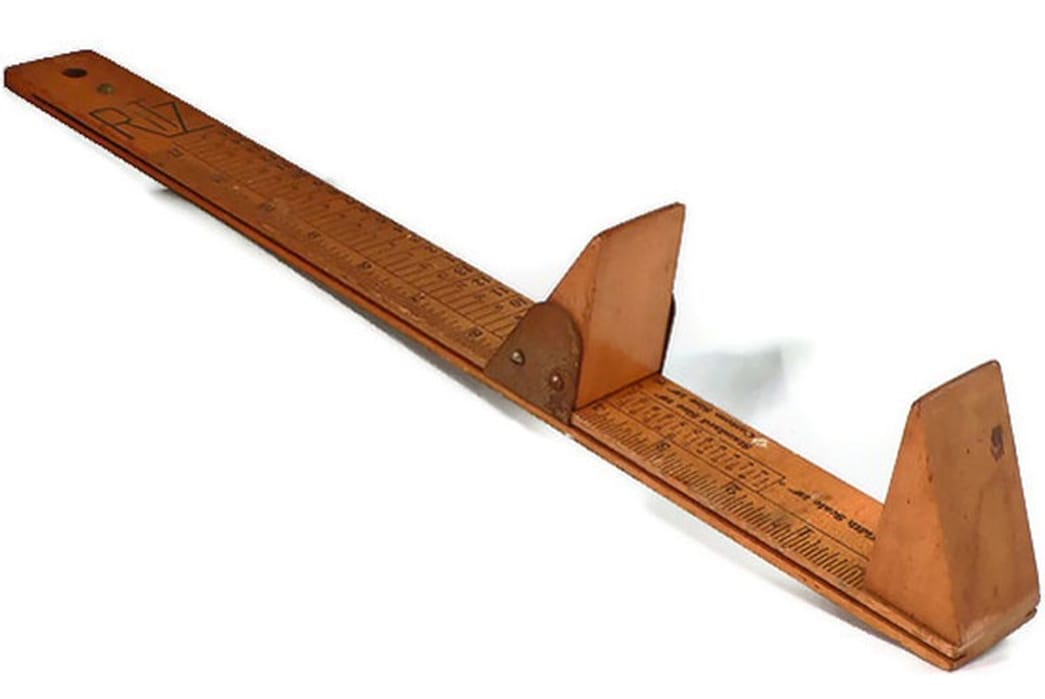
Brannock fiddled with sketches and graph paper before he eventually created a new grid-based measurement scheme that we all (in North America) know and love today. The eponymous Brannock Device measured not only the foot’s length but also its width and arch position. The system was linear: shoe sizes started with a size 1 at 7 and 1/3″ and increased by a full size every 1/3″, width was relative to size and labelled with letters from narrowest (AAA) to broadest (EEE) with a step every 3/16″. Hence our modern sizes like 8D or 11A. When a shoe fits “true to size” or “true to Brannock, that just means it adheres correctly to the Brannock grid.
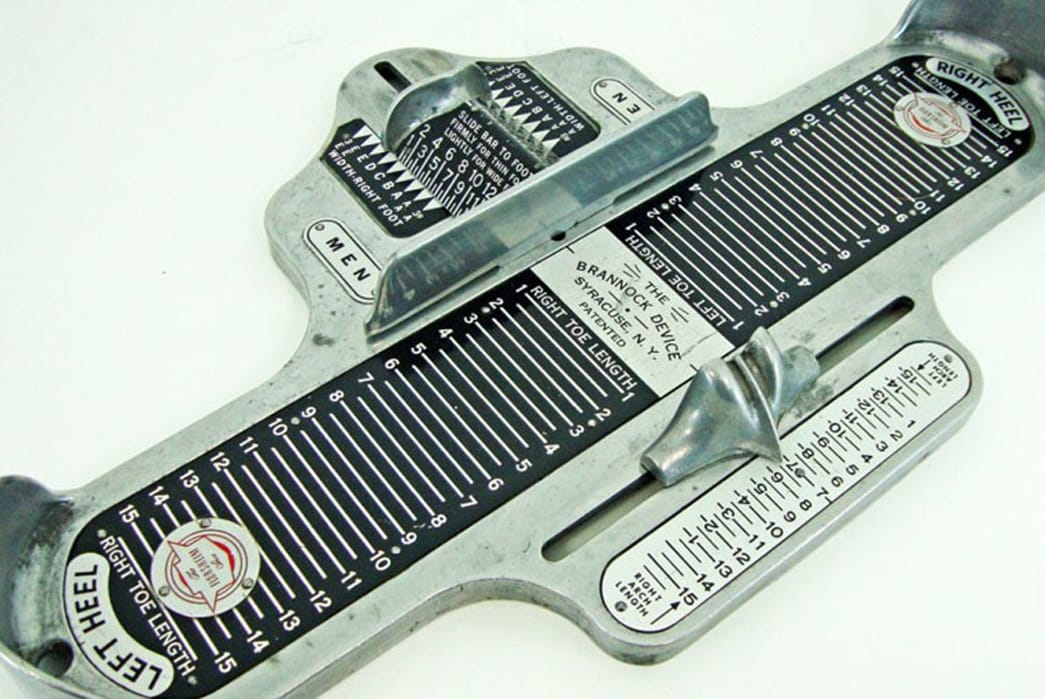
To use the device, the potential shoe-buyer first slips his or her foot into the heel cup. The salesman then slides the Brannock’s levers to lock onto the customer’s arch and foot width to note the size. The device is mirrored for both lengths, so the salesman merely has to flip the device around to measure the other foot. Brannock claims the system will get a customer’s fit right 95-96 percent of the time.

Brannock’s linear sizing system.
Brannock began to use the device as a sales tactic at his father’s shop in 1927, but filed a patent in 1929 when other shoe stores began to buy them to outfit their own customers. Brannock realized where the real money came from and soon opened up his own factory to produce the devices in the late 1930s.
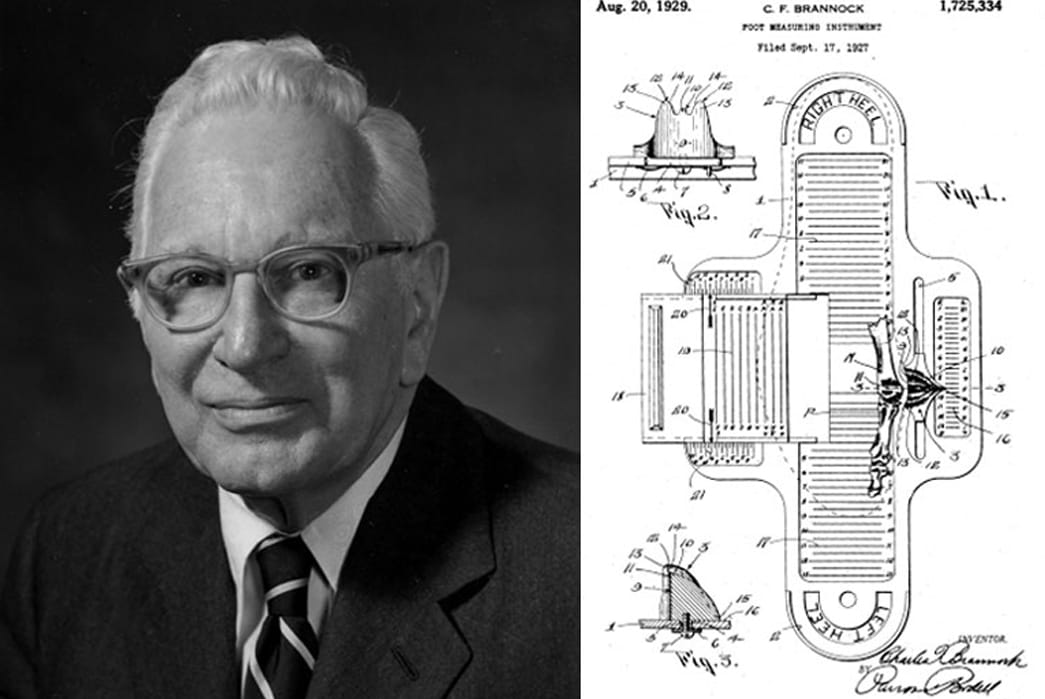
Charles F. Brannock and the patent for his device.
Like many US business owners, Brannock really made it big in WWII. The US military had spent millions of dollars to better equip soldiers with correctly sized equipment, so when they heard about the Brannock device, they ordered thousands upon thousands of them. The standard tool was a double Brannock device, so GIs could be measured on both feet at the same time.
The once regional measuring system was now the nationwide standard, but Brannock didn’t rest on his laurels. He was determined to produce the highest quality product. Stores would use the same device for decades and only needed to replace it when the numbers had worn off the steel.

Brannock continued to manufacture the devices in Syracuse until his death in 1993. Having no heirs of his own, Brannock negotiated the sale of his company to an Italian, Salvatore Leonardi, shortly before his death on the condition that production stayed in Syracuse and that the devices were still made out of steel to the same high-quality standard.
The patent has long since expired, and many companies produce knock-offs for a fraction of the price, but nothing will ever beat the original block of steel.
If you run a shoe store or just really like to measure your feet, you can pick up an original Brannock for $75 on Amazon.
Like this? Read these:

What did you think of today's newsletter? |