- Heddels
- Posts
- Nike Built a Made-In-Canada Air Jordan 1 and Never Released It
Nike Built a Made-In-Canada Air Jordan 1 and Never Released It

David Shuck
February 24, 2026
Nike Built a Made-In-Canada Air Jordan 1 and Never Released It
Nike explored producing an Air Jordan 1 with Viberg, but sadly, the project never saw the light of day.
Chris Danforth

In 2012, Gemo Wong, then Design Director of Special Projects at Jordan Brand, boarded a seaplane with his team bound for Victoria, British Columbia. Wong describes it as an “inspiration trip,” a chance to step out of Nike’s office in Beaverton and immerse himself in the workshop of Viberg, where Wong would meet owner Brett Viberg and see firsthand how one of Canada’s most respected bootmakers built its products.
“Americana was huge at the time. Brands like Red Wing were really popular. I wanted to see what would happen if Viberg built an Air Jordan 1,” Wong recalls. At the time, Nike CEO Mark Parker was championing craft across the company, says Wong. If Jordan Brand could tap into the ethos of a heritage bootmaker founded in 1931 and still run by the same family, what might that look like?
Inside Viberg’s factory, the brand’s process unfolds painstakingly. Each pair demands hundreds of individual steps. The brand has a reputation for using some of the best leathers available, in addition to custom components like nails and tacks from Japan, assembled by hand, and using nearly extinct pre-1940s machinery.
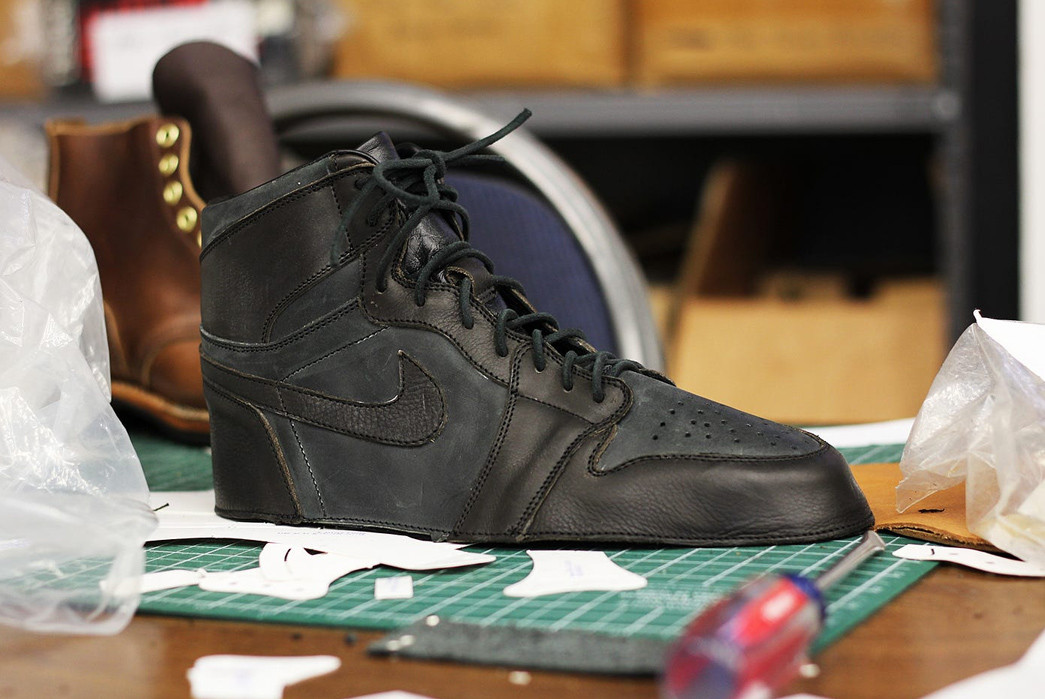
“Gemo basically gave us free rein,” Brett Viberg says. “Part of it was to explore, and use us as a guinea pig to create something more elevated. It was almost educational for them to understand our manufacturing. They also wanted us to document the whole process.”
Once back in Oregon, Wong packed up Jordan samples and shipped them north from Beaverton to Victoria. Using the original Air Jordan 1 as a foundation, Viberg began building a new version with Viberg’s “best leathers” at Wong’s request. The idea was straightforward but radical for its time: a made-in-Canada Viberg x Air Jordan 1, executed with the sensibility and materials of a heritage boot.
“I have all the patterns and the tech packs from the 1 up to the 11, I think,” Viberg says, an indication of the scope of freedom the project had on both sides.

The sample that emerged leaned more toward workboot than hardwood. “It was all black. It had this boot look to it,” Wong remembers. “Brett had some insane leathers. He used beautiful leather. I just remember the smell, that smell of leather times ten. The touch was beautiful. It had the aesthetic and character of a boot. We used boot laces too.”
Viberg layered in materials from some of the most revered tanneries in the world. “I ended up using a bit of Guidi leather, and I used some Horween leather as well,” he says. Guidi brought a high-fashion, avant-garde finish. Horween added a rugged, North American boot sensibility. The result was a bootmaker’s reinterpretation of a basketball icon.
This was years before the made-in-Italy luxury moment of the $2000 Dior Air Jordan 1, and before Jordan Brand’s ’85 series, which would reintroduce the 1 with heightened attention to detail. At that point, no Jordan sneaker had been produced with this level of old-world construction and material indulgence.

“I’m always trying to find a story attached to these projects, and I wasn’t able to find the story that just clicked.”
And yet, it was never released.
Wong reveals the project was “one of many” that he explored but never released at Jordan. “It came out of just being friends and respecting Brett’s craft and ability to make nice stuff,” he says. Viberg notes being struck by Jordan Brand’s openness. “Their creative process seemed very open, and I found that interesting. They reference and pull from a lot of areas.”
“I’m always trying to find a story attached to these projects, and I wasn’t able to find the story that just clicked,” Wong says. For all its material richness and craft credibility, the collaboration lacked a narrative hook that could anchor it within the broader Jordan universe.

In 2012, the sneaker collaboration landscape was only beginning to take shape. Jordan partnerships largely operated through friends and family circles. That year included projects with English artist Dave White and Miami retailer SoleFly. Around the same period, figures like Hiroshi Fujiwara were bringing new formulas for future sneaker collaborations
“That’s when the collaboration thing started just taking off,” Wong remembers. “Hiroshi, and a couple of others.”
In another timeline, the Viberg project might have anticipated the rise of luxury sneakers by several years. Instead, it remains a tantalizing what-if moment.
Like this? Read these:


What did you think of today's newsletter? |